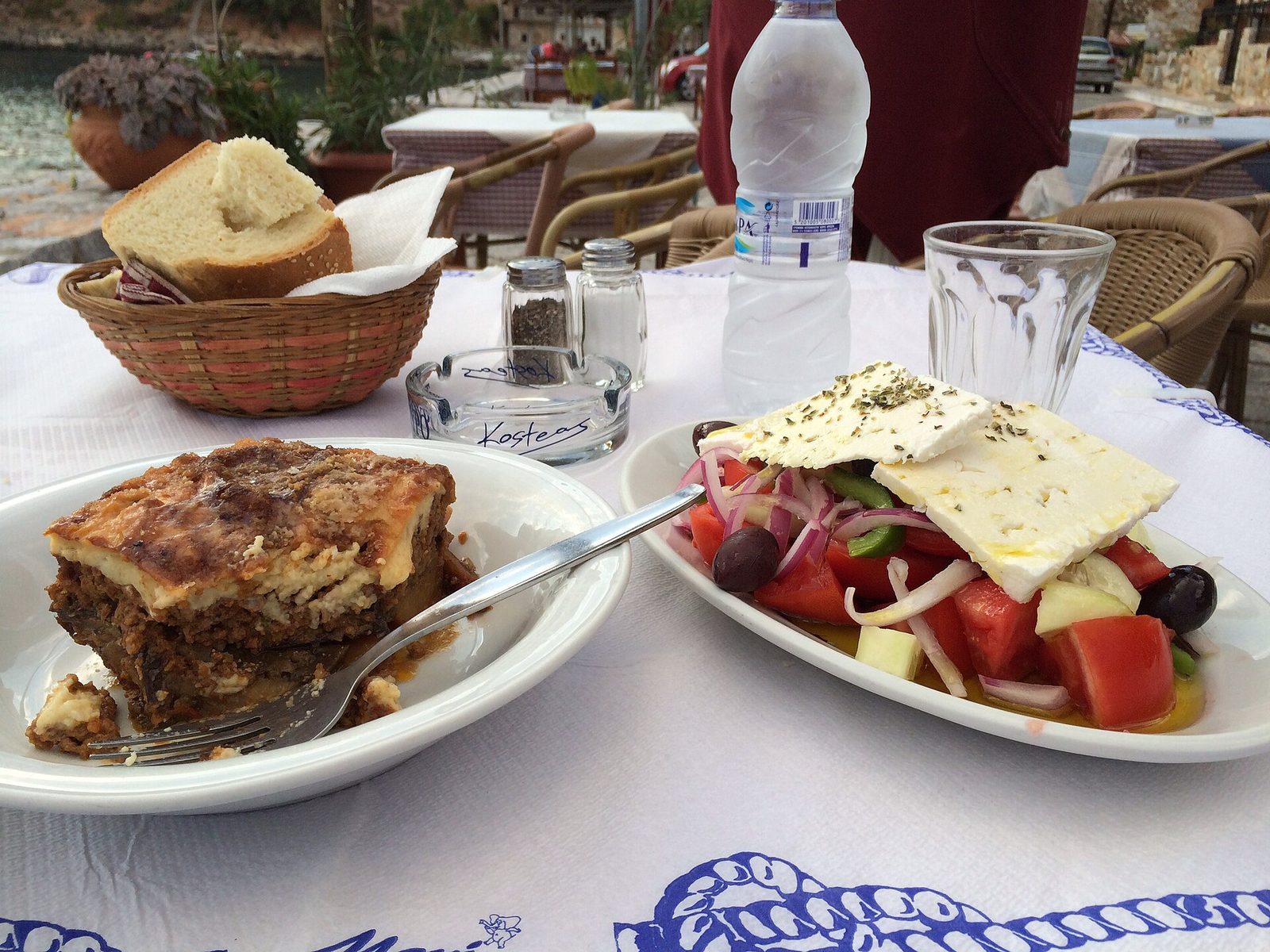
Messinian cooking is Greek country and seaside cooking: few ingredients, plenty of olive oil, seasonal vegetables and simple methods. It is not a cuisine that shows off, and that is exactly why it works.
How to order in a taverna
The first thing to understand is that a Greek taverna does not work in courses like an Italian restaurant. You order a number of dishes for the table and share them: the meze, the starters, arrive first and are often enough to make a meal on their own.
Among the classics found almost everywhere are tzatziki, made with yoghurt, cucumber and garlic, melitzanosalata made with aubergines, taramosalata, dolmades (stuffed vine leaves) and fried vegetables. To these you always add a salad: the choriatiki, the “village” salad, with tomato, cucumber, onion, olives, oregano and a whole slab of feta on top.
Then come the main dishes, which fall roughly into two families: grilled ones (souvlaki, chops, fish) and oven-baked ones, the so-called magirefta, cooked in advance and served warm. Moussaka, stuffed vegetables, roast lamb with potatoes: these are home-style dishes, and in many tavernas they are the best part of the menu.
Fish
On the coast, fish is the natural choice. In Marathopoli, the fishing village a few kilometres from the house, the seafront tavernas come alive mainly in the evening, with Proti Island in front and the sun setting right behind it. In Greece fish is usually ordered by weight: you choose it, it is weighed and then cooked, almost always grilled with oil and lemon.
Small tavernas change their fish every day depending on what has come into the harbour: asking what is fresh is not a formality, it is the right way to order.
Cooking at home
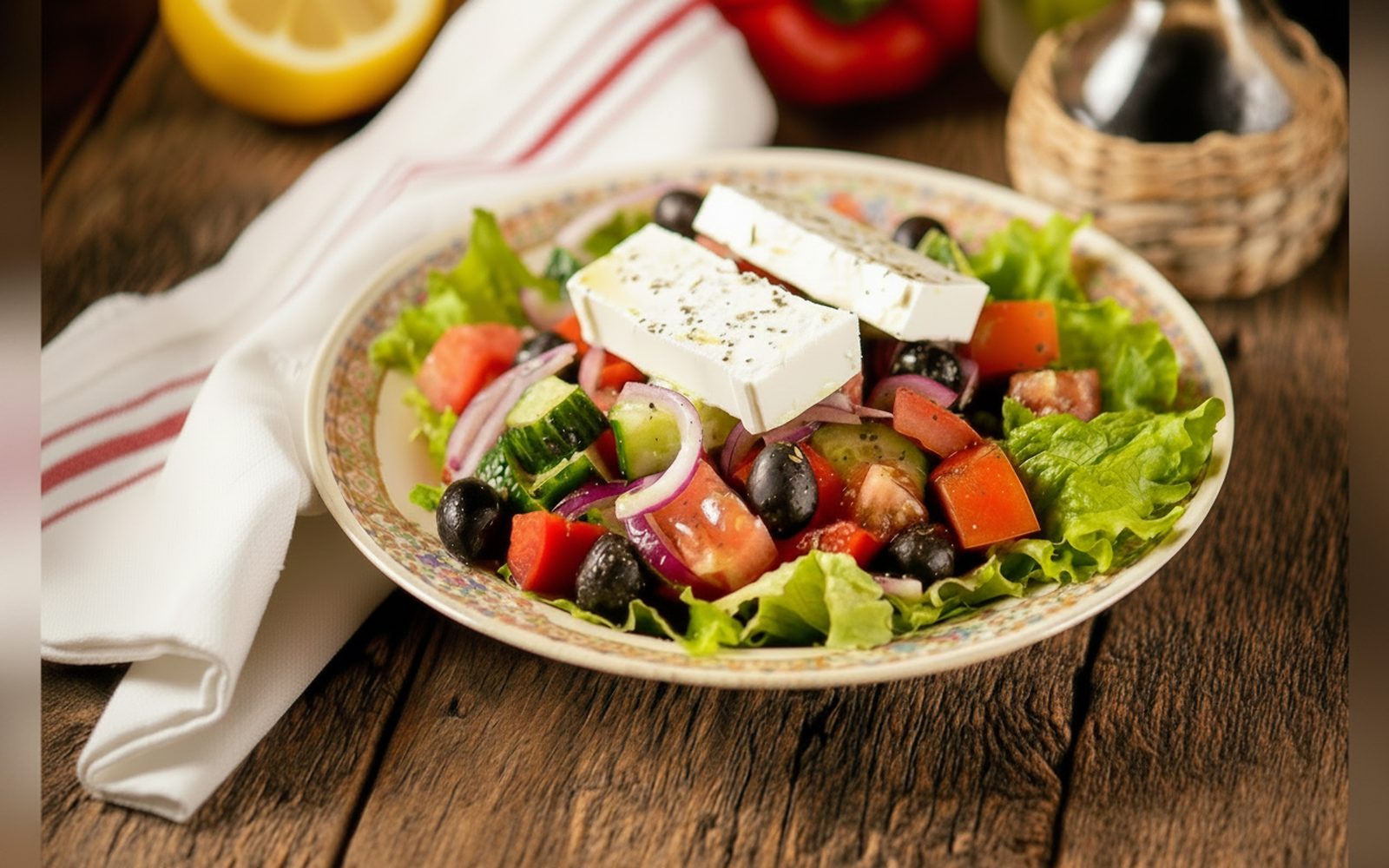
If you are staying in a house with a fully equipped kitchen, you have an alternative worth making the most of on at least a couple of evenings. At the market and in village shops you will find seasonal vegetables, feta, olives and bread, and in Marathopoli you can buy fish. With the barbecue area in the garden the rest follows naturally: grilled fish or meat, a salad, good oil, and dinner in the garden as the evening cools down.
It is also the cheapest way to eat well on holiday, and in a place with ingredients like these it is anything but a compromise.
The end of the meal
In village tavernas, something you did not order often arrives at the end of the meal: a dessert, some fruit, a small glass of something. It is not a mistake on the bill, it is a local custom. The right response is to accept.
Customs worth knowing
In Greece people dine late. In the villages the tavernas start filling up around nine in the evening and stay busy for a long time: turn up at seven and you will often find an empty dining room and a kitchen still getting going. Adapting to local hours is not just about atmosphere, it is also the way to eat better.
Bread arrives at the table and is usually charged separately, like a cover charge: it is not an arbitrary addition to the bill. Tap water is normally served in a jug. And almost everywhere you simply ask for the bill at the table, without any fuss.
What to look for beyond the classics
Beyond the dishes everyone knows, it is worth asking what is in season. In spring, boiled wild greens dressed with oil and lemon, the horta, appear and go with everything; in summer there are vegetables stuffed with rice and herbs, the gemista, baked in the oven for hours.
In village tavernas the most interesting part of the menu is often the part that is not written down: the dishes of the day, made with whatever is available. Asking for them is the right move, and the cooks generally appreciate it.
A fully equipped kitchen and a barbecue in the garden
The house has a kitchen complete with appliances and tableware, and a barbecue area among the olive trees: dinner outdoors, with fish bought in Marathopoli.
And in the house you will find the extra virgin olive oil and the soap made from the olives of our own grove.