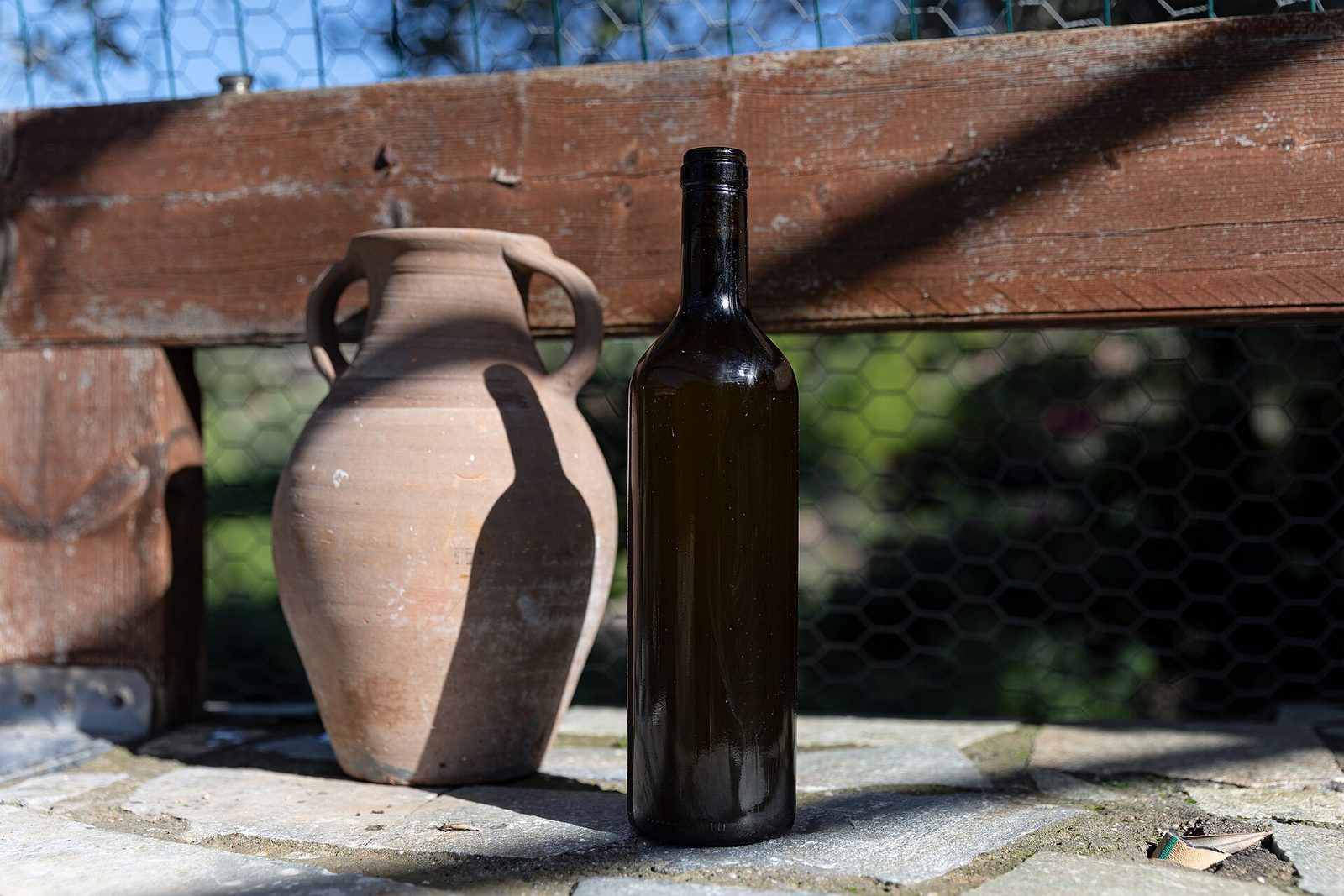
Driving through Messinia you pass through olive groves for kilometres, an unbroken stretch from the coast to the first hills inland. This is not decorative scenery: it is one of the most important olive-growing regions in Greece, and the olive tree has been the main crop here for thousands of years.
Two varieties, two jobs
The olives you see on the trees are not all the same, and above all they do not all end up in the same place. The dominant variety for oil is Koroneiki: a small fruit, a high yield and an oil with a distinctly grassy note. It is the one that fills the mills from October onwards.
The Kalamata olive is something else: large, elongated and dark purple, it is picked by hand because it bruises easily, and it goes into brine, not to the mill. It is the table olive that made the name of this city familiar halfway around the world, and in Greece it is protected by a designation of origin.
How to recognise good oil
New oil, the oil of the harvest months, can be recognised by eye before you even taste it: it is deep green and cloudy, because it has not fully settled yet. On the palate it has a clear bitterness and, above all, a peppery tickle in the throat, the pungency that many people mistake for a flaw but that is actually the sign of polyphenols, in other words of freshness and quality.
An oil that has no bite at all, sweet and flat, is either old or made from late-harvested olives. Tasting freshly milled oil on a piece of bread and nothing else is still the best way to understand the difference.
Buying it here
In Messinia there are many ways to buy oil: in village shops, at the mills’ own shops, at farming cooperatives. It is worth asking about the vintage and, if possible, tasting it: in most places this is perfectly normal.
If you are travelling by car and going home by ferry, taking a few bottles with you is easy. If you are flying, remember that liquids cannot go in the cabin: bottles must go in the hold, well wrapped, or you can choose a small tin. It is the most sensible souvenir you can take home from here.
The olive trees around the house
The garden of Navarino Greek House is itself an olive grove, with fruit trees and the barbecue area among the olives. In autumn, when the harvest begins, you understand what it means to live among the olives: the sound of the harvesting machines in the nearby fields, the nets spread out, the vans heading down to the mills.
How to taste it
There is a method to tasting oil, and it is not complicated. Pour a little into a glass, warm it with one hand while covering it with the other, smell it, then take a small sip, drawing air in through your teeth to spread it around your mouth. The three things to look for are fruitiness on the nose, bitterness on the tongue and pungency in the throat.
The most common mistake is to misjudge the pungency: that burning sensation that makes you cough is not a flaw but the signature of a young oil rich in polyphenols. The real flaws are different, and you recognise them by smell: a rancid smell, a musty one, the smell of fermented olives.
What to use it with
A new, intense oil is not meant for everything. It is at its best raw, on bread, boiled vegetables, pulses and grilled fish, where its bitterness provides a contrast. For long cooking and frying, people generally use a more neutral oil, or at least not the one fresh from the mill.
In any case, olive oil consumption per head in Greece is among the highest in the world, and in home cooking it is everywhere, from roast vegetables to desserts. It is not a dressing: it is an ingredient.
Sleeping in an olive grove
The house is surrounded by its own olive grove and an orchard, with a barbecue area and a hot tub: rural Messinia begins right outside the door.
And in the house you will find the extra virgin olive oil and the soap made from the olives of our own grove.