Eleven kilometres from the house, on a hill near Chora, lies one of the most important archaeological sites in mainland Greece: the Palace of Nestor. It is not spectacular in the way temples with standing columns are. It is something different and, in some ways, rarer.
What you actually see
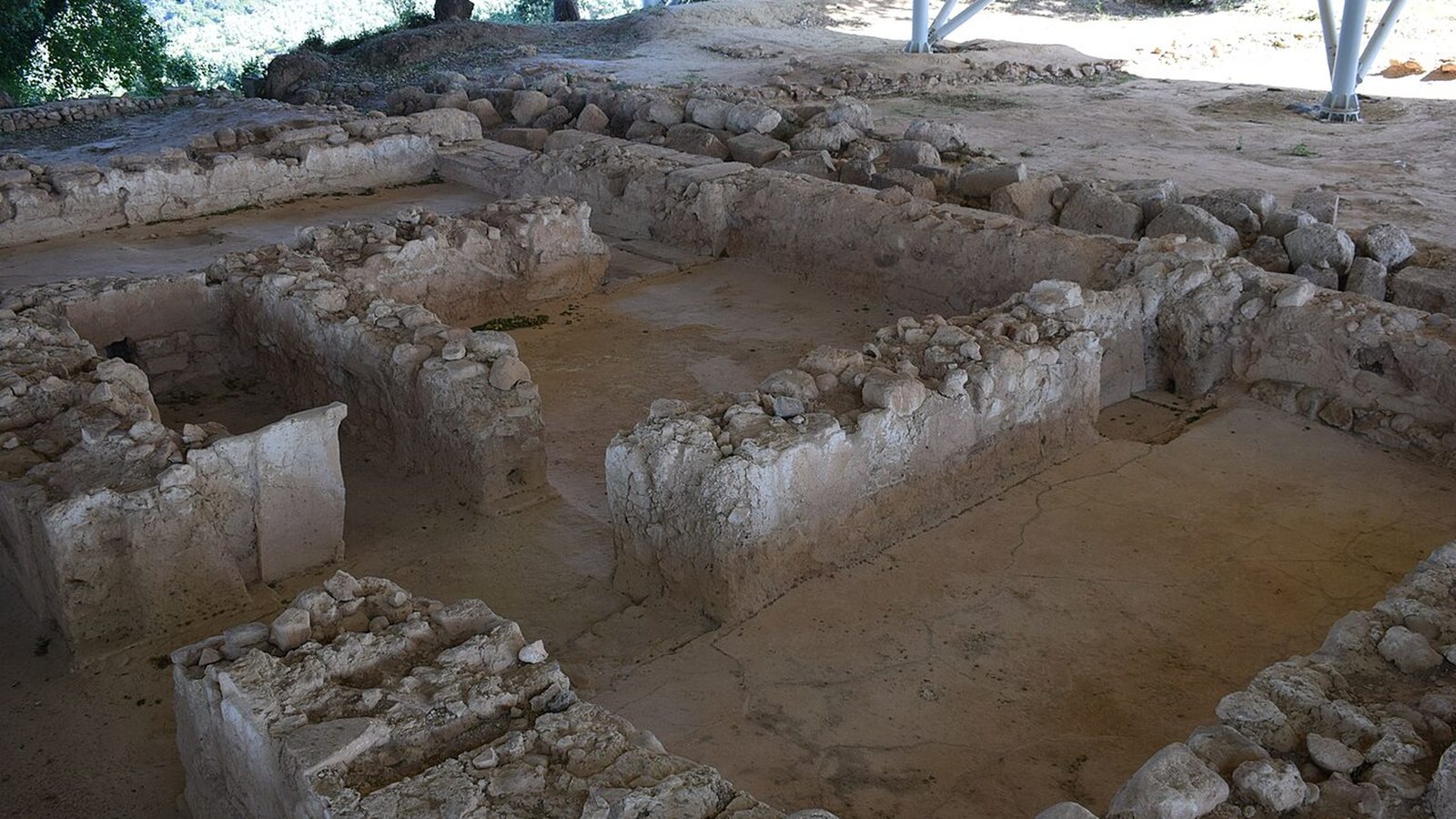
What remains are the low walls of the building, a few tens of centimetres high, which trace the complete plan of the palace on the ground. You can make out the storerooms, the corridors, the service areas and, above all, the great central megaron, the throne room with its circular hearth in the middle. Walking along the walkways, you follow the layout of the rooms as if you were reading a life-size floor plan.
It is an experience that takes a little imagination, but it gives you something almost no other Mycenaean site offers: an understanding of how a Bronze Age palace was actually organised.
The Nestor of the Odyssey
Tradition identifies this palace with the home of Nestor, the wise old king of Pylos who in the Odyssey welcomes Telemachus, who has come in search of news of his father Odysseus. Homer describes the hospitality, the sacrifice, the bath offered to the guest: details that take on a different weight when you read them while looking at the actual plan of the building.
The tablets that changed everything
The most important discovery made here, however, has nothing to do with Homer. In the excavations that began in the late 1930s, more than a thousand clay tablets were found inscribed in Linear B, the syllabic script of the Mycenaean palaces. They were administrative records: inventories, registers of goods, lists of personnel.
Those tablets, together with the ones from Knossos, made it possible to decipher Linear B and to prove that the language it recorded was an archaic form of Greek. It was one of the most important achievements of twentieth-century philology, and it pushed the documented history of the Greek language back by centuries. The paradox is that the tablets survived precisely because the palace burned down: the unbaked clay, fired by the blaze, became indestructible.
Planning your visit
The site is covered by a modern protective roof, which shelters the remains from the weather and, as a result, visitors from the sun. This makes it one of the few open-air sights in the area that still work well in the middle of a summer day, when the rest of Messinia is hard going.
A good hour is the right amount of time to see it at a relaxed pace. In the same municipality, in Chora, there is also the archaeological museum that houses the finds from the excavations: the two visits fit naturally into the same morning.
How to read the ruins
To find your way around the plan, it is best to start from the centre. The megaron is the large rectangular hall with the circular hearth in the middle and the traces of the four columns that held up the roof: it was the ceremonial heart of the palace, the room where the king received visitors. The service areas spread out around it, and it is these that tell the most concrete stories.
There are the oil storerooms, recognisable by the rows of stands for the large jars; there is the pantry where thousands of stacked cups were found, a sign of banquets on a grand scale; there is even a room identified as a bathroom, with the tub still in place. A Mycenaean palace was first and foremost a centre for collecting and redistributing goods, and the plan says so clearly.
The museum in Chora
The finds from the excavations are not kept on site but in the archaeological museum in Chora, a short distance away. It is a small museum that takes less than an hour to visit, and it rounds off the walk among the ruins nicely: pottery, metal objects and grave goods from the tholos tombs of the area.
If you only have time for one of the two, visit the site; if you do both, site first and then museum, you come away with a much fuller idea of what this part of Messinia was like three thousand three hundred years ago.
Eleven kilometres of history
Navarino Greek House lies between Marathopoli and Navarino Bay: the Palace of Nestor, Pylos and Voidokilia are all within a twenty-minute drive.
And in the house you will find the extra virgin olive oil and the soap made from the olives of our own grove.