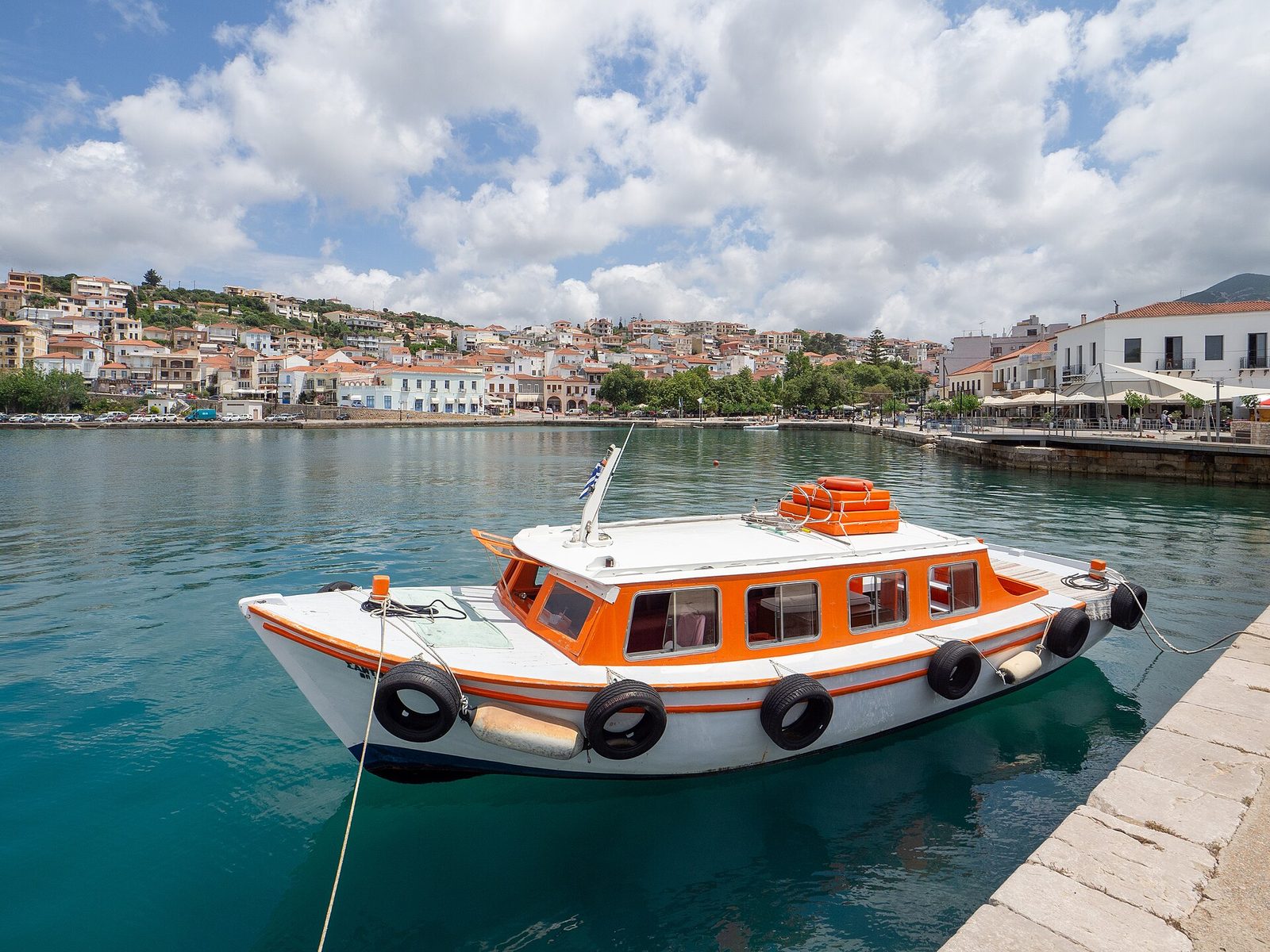
Pylos is the main town in this corner of Messinia: about twenty minutes by car from the house, overlooking Navarino Bay. It is where you go when you feel like a real town, with a square, cafés and little shops, rather than another stretch of coast.
The square of the plane trees
The heart of the town is the main square, shaded by large old plane trees that make a huge difference in the hottest hours. Around it are cafés with tables outside, little shops and the monument to the admirals of the allied fleets. It is the kind of square where you sit down for twenty minutes and end up staying an hour.
From there it is a few steps down to the harbour: fishing boats, a few pleasure craft and the waterfront that closes off the town towards the bay.
Niokastro
Above the town rises Niokastro, the “new castle”, built by the Ottomans in the sixteenth century to control the southern entrance to Navarino Bay. It is called “new” to distinguish it from Navarino Castle, the medieval one at the opposite end of the bay, above Voidokilia.
The complex is large and preserves its walls, bastions, citadel and several buildings inside. From the ramparts you can take in the whole bay: the island of Sphacteria closing it off from the open sea, the entrance, the harbour below. It is the best way to understand the shape of this stretch of water, one of the most sheltered natural anchorages in the eastern Mediterranean.
The bay and its history
This bay has seen two military episodes more than two thousand years apart. In the fifth century BC, during the Peloponnesian War, the island of Sphacteria was the scene of a battle in which a Spartan force surrendered to the Athenians: an event that caused an enormous stir, because Spartans, by reputation, did not surrender.
In October 1827, on the other hand, the naval Battle of Navarino was fought here: the allied fleets of Britain, France and Russia destroyed the Ottoman-Egyptian fleet in a few hours. It was a decisive step towards Greek independence, and it is why the square in Pylos is dedicated to the three admirals. Looking at the bay from Niokastro, the course of the battle suddenly becomes easy to follow.
How to plan the half day
The plan that works best is simple: the fortress early in the morning, when it is pleasant to walk, then down to the square for a break in the shade of the plane trees and a wander round the shops, and back to the sea in the early afternoon. Pylos is also the right place for a proper shop, the kind you cannot do in Marathopoli.
Inside the fortress
Niokastro is not just walls. Within the fortified perimeter are the hexagonal citadel, a church whose function has changed several times over the centuries with the fortunes of the area, and several restored buildings that house exhibition spaces. The complex has undergone restoration work, and the area open to visitors has grown over the years.
Walking all the way round the walls takes a good hour, and the most rewarding part is the rampart walk towards the sea: from there you can keep an eye on the entire southern entrance to the bay, which is exactly why the fortress was built on that spot.
Pylos as a base for services
Beyond sightseeing, Pylos is the town that takes care of the practical needs of anyone staying in the area: this is where you find the services the villages lack, from pharmacies to cash machines, from the best-stocked supermarkets to petrol stations. If you are staying in the countryside it is useful to know, and worth a trip in the first few days.
Finally, the harbour is where boat trips leave in season for the bay and the island of Sphacteria. What is on offer depends on the time of year and the sea conditions: it is something to check on the spot, not to take for granted before you set off.
Twenty minutes from Navarino Bay
The house is between Marathopoli and Pylos, with Voidokilia and the Palace of Nestor a few kilometres away: a location that lets you see a lot without ever driving for long.
And in the house you will find the extra virgin olive oil and the soap made from the olives of our own grove.