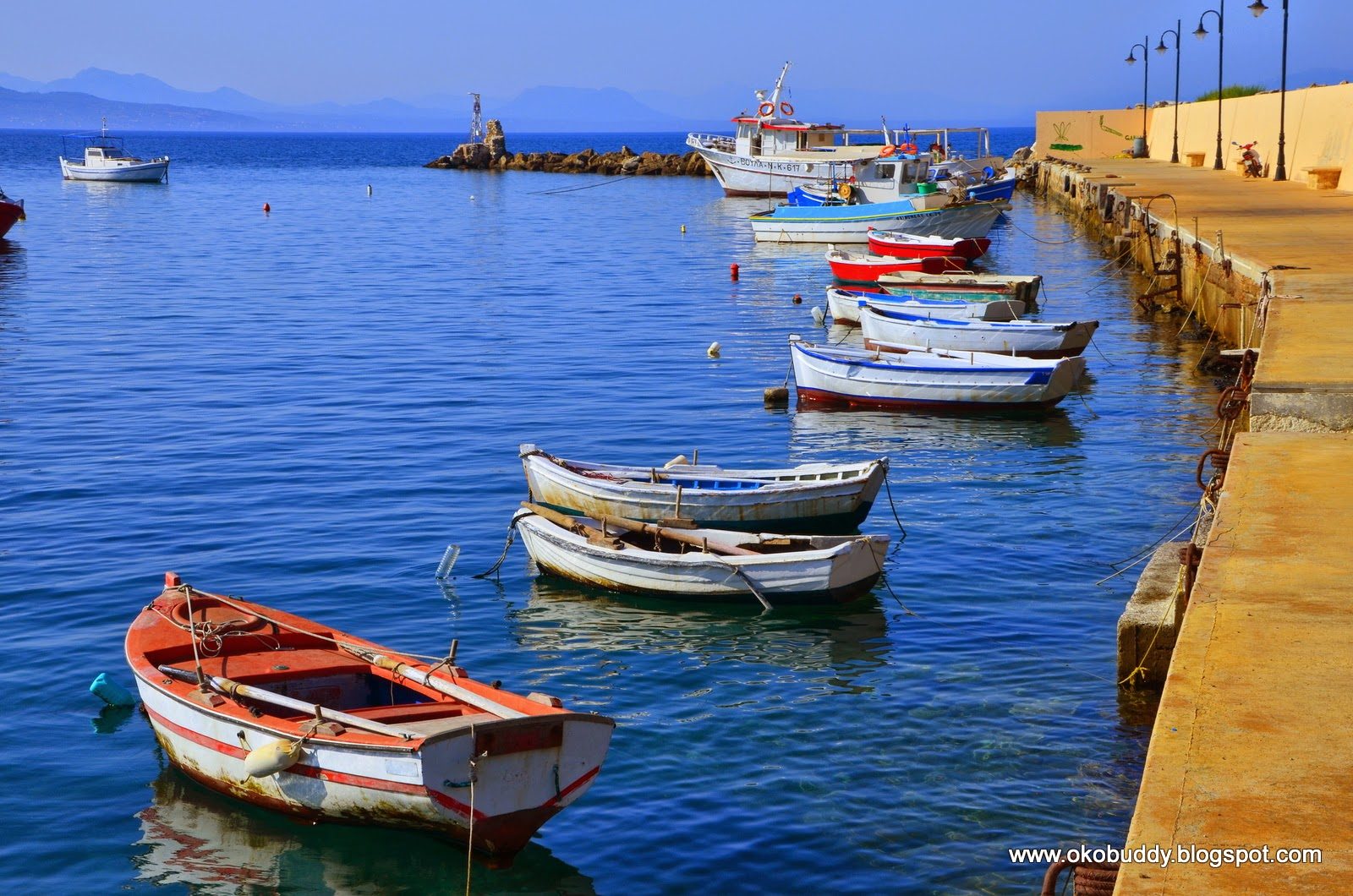
Messinia out of season: spring and autumn without the crowds
Empty beaches, archaeological sites all to yourself and villages that go back to being villages. Why the shoulder seasons are the best time to come.
When to comePublished · September 20268 min read
Sunset on the Ionian coast
There is a version of Messinia that people who only come in August never see. It is the Messinia of April and May, of September and October: the same coast, the same sea, but without the squeeze of high season. For many, it is simply the best version.
The beaches
This is the most obvious difference. Voidokilia on a weekday in May or October is almost deserted: you can walk the whole arc of the bay without meeting anyone and appreciate its omega shape as at no other time. The same goes for the smaller coves along the coast, which in summer call for an early start and out of season simply call for nothing at all.
As for water temperature, September and the first half of October are when the sea is at its warmest of the whole season: it has been storing heat for three months and releases it slowly. In spring it is the opposite: in May the water is still cool, and it takes a bit of resolve.
The sites and fortresses
Walking around Ancient Messene, climbing up to Navarino Castle or exploring the fortress of Methoni at twenty-five degrees instead of thirty-eight transforms the experience. They are all large sites, mostly unshaded, and in high summer they force you onto a strict timetable. In the shoulder season you can visit whenever you like, at your own pace.
Bear in mind that opening hours at Greek archaeological sites are generally shorter in winter than in summer: it is the only thing to check in advance.
Out of season, Messinia's villages go back to being what they are all year round. The tavernas that stay open cater mainly to locals, the pace slows, and newcomers get noticed, in a good way. It is the time when you end up chatting with someone, which does not happen in mid-August.
In autumn, too, the countryside is busy with the olive harvest, which gives the whole region a bustle it lacks in summer.
What to expect
The shoulder seasons call for a little flexibility. Some seasonal businesses on the coast cut their hours or close, and the weather is less predictable: it can rain in spring and autumn, so pack a light jacket and have a plan B for a day indoors.
On the other hand, travel costs drop considerably, the roads are clear and there is no need to book anything months in advance.
What stays open
The question everyone asks before booking out of season is whether they will find anything open. In Messinia the answer is generally yes: unlike some islands, this is an area that is lived in all year round, with a farming economy that does not depend on tourism. The villages function, the shops are there, and the tavernas that serve locals stay open.
What is reduced is the seasonal offering on the coast: some beachfront bars and restaurants close, as do some of the rental and excursion businesses. Archaeological sites and fortresses change their opening hours, which are shorter in the winter season.
The value of the light
There is an aesthetic reason, as well as a practical one, for coming in the shoulder seasons. In spring (April and May) and in October the sun is lower and the light is soft for much of the day, not just at dawn and dusk. The photos you bring home from an October trip are, quite simply, better than those from August.
The same goes for the landscape: in spring the inland hills are a green that is unthinkable in summer, and in autumn the countryside at work on the olive harvest gives the area a liveliness you never see on postcards.
If we had to choose: the second half of September. The sea at its warmest of the year, beaches already empty, days still long and villages just freed from the August crush.
A house that works all year round
Air conditioning, a full kitchen and an outdoor Jacuzzi: out of season, the house is the right place to enjoy Messinia in peace and quiet.
And in the house you will find the extra virgin olive oil and the soap made from the olives of our own grove.
Through the availability request form and the contact channels we collect your first name, surname, email or phone number, dates of stay, number of guests and any free-text message. Providing this information is necessary in order to reply to your request.
2.2 Data collected during your stay
On arrival, guests' identification details may be collected, to the extent required by the registration obligations under the law applicable where the property is located.
2.3 Browsing data
The systems acquire data implicitly transmitted through Internet protocols (IP address, browser, pages visited, times) for anonymous statistics and for the security of the Website.
2.4 Cookies
The Website only uses technical tools that are necessary for it to work, as detailed in the Cookie Policy. It does not use profiling cookies or analytics tools.
2.5 Virtual assistant
If you choose to use the virtual assistant on the Website, the text of the messages you write is sent to the service provider's server to generate the reply. Please do not enter unnecessary personal data in the chat: to book, use the form or WhatsApp.
3. Purposes and legal basis
Purpose
Legal basis (Art. 6 GDPR)
Responding to requests and managing bookings
Pre-contractual measures, Art. 6(1)(b)
Performance of the accommodation contract
Performance of a contract, Art. 6(1)(b)
Tax and accounting obligations
Legal obligation, Art. 6(1)(c)
Guest registration obligations
Legal obligation, Art. 6(1)(c)
Website security and defence of legal claims
Legitimate interest, Art. 6(1)(f)
4. Processing methods
Data are processed by automated and non-automated means, only for as long as strictly necessary for the purposes, with appropriate technical and organisational measures pursuant to Art. 32 GDPR.
5. Recipients of the data
Competent authorities, where required by guest registration obligations;
Accounting and tax advisers, acting as data processors pursuant to Art. 28 GDPR;
Technical providers (hosting, email, virtual assistant, request management), acting as data processors;
Booking platforms (OTAs), solely for bookings made through those channels;
Law enforcement authorities, where required by law.
Data are not disseminated or used for profiling.
6. External resources and transfers outside the EEA
To display its pages, the Website loads some resources from external providers: fonts from Google Fonts, the calendar and map libraries from jsDelivr and the map tiles from OpenStreetMap. In these cases the only data processed is the IP address needed to deliver the resource. Any transfers outside the European Economic Area take place on the basis of the EU-US Data Privacy Framework or Standard Contractual Clauses.
7. Retention period
Requests that did not lead to a booking: up to 12 months;
Completed stays: for the period required by applicable accounting and tax obligations;
Browsing data: as a rule, no longer than 12 months.
8. Rights of the data subject
Under Articles 15-22 GDPR you may exercise your rights of access, rectification, erasure, restriction of processing, portability and objection, and the right not to be subject to automated decision-making.
To exercise your rights, write to info@navarinogreekhouse.com enclosing a copy of an identity document. You will receive a reply within 30 days.
9. Complaint to the supervisory authority
You may lodge a complaint with the competent data protection supervisory authority of the Member State in which you habitually reside or work, or where the alleged infringement took place.
10. Changes
The Controller may amend this notice at any time by publishing the updated version on the Website.
Document drawn up in accordance with Regulation (EU) 2016/679 (GDPR).
Notice on the use of cookies and similar technologies, provided in accordance with Directive 2002/58/EC and Regulation (EU) 2016/679.
1. What cookies are
Cookies are small text files that websites send to the user's device, where they are stored and then sent back on subsequent visits. Similar technologies, such as the browser's local storage (localStorage), work in the same way and are covered here together with cookies.
2. What this website uses
The Website does not use profiling cookies or third-party cookies. No advertising pixels, no social media trackers, no analytics tools. That is why you are not asked for any consent when you open the pages.
3. Technical tools
Language preference Technical
Remembers the language you chose from the selector at the top (Italian, English, French, Spanish or German), so that on your next visit the page opens directly in your language.
Name
navarino_lang_v1
Type
Browser localStorage
Duration
Until deleted from the browser
Consent
Not required
Virtual assistant Technical
A random code that distinguishes your conversation with the virtual assistant from those of other visitors. It contains no identifying data and is not used to profile you.
Name
azc-session-id
Type
Browser localStorage
Duration
Until deleted from the browser
Consent
Not required
OpenStreetMap map Technical
The interactive map on the Website is built with the Leaflet library and OpenStreetMap tiles. It does not set cookies.
Cookies
None
Consent
Not required
4. Third-party resources without cookies
The Website loads its fonts from Google Fonts and some libraries from jsDelivr. These resources do not set cookies: the provider only receives the IP address needed to deliver them. More details in section 6 of the Privacy Policy.
5. How to manage cookies and local storage
You can delete the data stored by the Website at any time from your browser settings: Chrome, Firefox, Safari, Edge. The Website will keep working: it will simply ask you for your language again.
The natural or legal person who makes the booking through the Website, the direct channels or the booking platforms.
2. Subject matter and scope
These Terms govern the booking and temporary use of the property for tourist accommodation purposes. Making a booking implies full acceptance of these Terms.
3. Booking procedure
A request made through the Website does not constitute confirmation: it becomes binding only upon written confirmation from the Operator. The house sleeps up to 6 people in two bedrooms.
4. Prices and payment
Prices are quoted in euros and include the services specified at confirmation. Payment terms (deposit, balance, deadlines and accepted methods) are communicated by the Operator when the booking is confirmed and form an integral part of these Terms.
5. Changes and cancellation
The applicable cancellation policy is the one communicated by the Operator when the booking is confirmed or, for bookings made through OTAs, that of the platform used.
The Operator may cancel the booking in the event of force majeure, refunding all amounts paid in full.
6. Arrival, departure and documents
Check-in and check-out times and arrangements are communicated by the Operator when the booking is confirmed;
On arrival, an identity document may be requested for the registration formalities required by applicable law;
The number of guests may not exceed the capacity of the house. The presence of unregistered persons will result in termination without refund.
7. Obligations during the stay
The Guest shall use the property with due care and diligence, respect its spaces and equipment, respect the peace and quiet of the neighbourhood and promptly report any damage or malfunction to the Operator. The hot tub, the barbecue area and the outdoor spaces are used at the Guest's own responsibility, and the Guest shall in particular supervise minors.
8. Liability
The Guest is jointly and severally liable, together with the members of their party, for any damage caused to the property. The Operator is not liable for valuables left unattended, for interruptions to external services (electricity, water, connectivity) or for events of force majeure.
9. Consumer right of withdrawal
For contracts for the provision of accommodation for purposes other than residential with a specific date of performance, EU consumer protection law excludes the 14-day right of withdrawal. The cancellation rules set out in § 5 therefore apply.
10. Data protection
Personal data are processed in accordance with Regulation (EU) 2016/679. Please refer to the Privacy Policy and the Cookie Policy.
11. Governing law and jurisdiction
The contract is governed by the law of the State in which the property is located. For disputes with Customers who qualify as consumers, the mandatory provisions protecting them remain applicable, including the jurisdiction of the courts of the consumer's place of residence or domicile.
12. Changes to the Terms
The Operator may amend these Terms by publishing the updated version on the Website. Bookings already confirmed are governed by the Terms in force on the date of confirmation.
Terms drawn up in accordance with the EU consumer protection rules applicable to accommodation contracts.